
Six moves, one cord六步,一根绳
The Pan Chang knot, taken apart. No glue, no stitching, no shortcuts — the cord holds itself through tension and over-under crossings.把盘长结拆开来看。不用胶、不用针线、没有捷径——这根绳靠张力与上下相压,把自己固定住。
Before you start开始之前
What you need需要准备
A single length of satin cord, a flat surface, and something to hold the work while both hands are busy.一根缎绳、一个平的台面,以及一个能在你两只手都忙着时固定住它的东西。
- Cord绳
- 4 mm satin or nylon cord, 1.2–1.5 m. Too soft and the loops collapse; too stiff and they will not lie flat.4 毫米缎绳或尼龙绳,1.2–1.5 米。太软,耳会塌;太硬,耳躺不平。
- Pins珠针
- A foam board and T-pins, or a clipboard. Pinning is not cheating — professional knot makers use boards.一块泡沫板加 T 形针,或者一个夹板。用针固定不算作弊——专业结艺师也用板。
- Scissors剪刀
- Sharp, for a clean cut. A lighter to seal nylon ends (adult supervision).要快。尼龙绳的端头可以用火机燎封(需成人看护)。
- Tape measure软尺
- Loops should match; measure once at the start and once at the end.耳要一样大;开始量一次,收尾再量一次。
The one rule唯一的原则
Every crossing must go over, under, over, under. If two cords run parallel without weaving, the knot will not lock — it will slide apart the moment you let go.每一处交叉都必须上、下、上、下。如果两根绳平行而没有交错,结就锁不住——手一松,它就会滑开。
Tension is the second rule. A Pan Chang is judged by its evenness, not by how tight it is.张力是第二条。盘长结看的是匀,不是紧。
Step by step分步图解
Tying the Pan Chang编一个盘长结
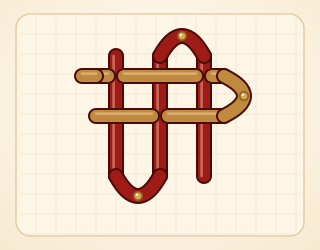
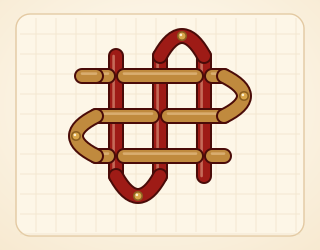
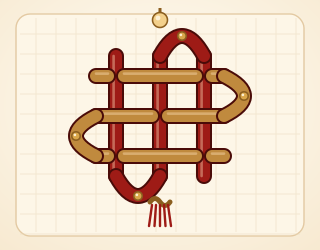
Diagrams are schematic: red is the first pass of the cord, gold is the second. Arrows mark the working end.图为示意图:红色是绳的第一遍走向,金色是第二遍。箭头指出工作端下一步的方向。
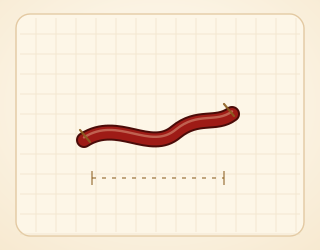
Cut and seal截取与封口
Cut 1.4 m of cord and seal both ends. Lay it in a shallow curve — this is your working length, and it will shrink by about a third once tightened.剪 1.4 米,两端封口。把它摊成一道浅弧——这是你的工作长度,收紧后会缩短约三分之一。
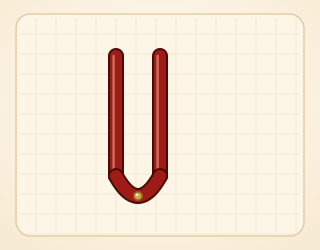
Form the first loop起第一个耳
Pin the centre. Bring the right-hand end over the left to make a loop the size of a thumbnail, and pin the crossing so it cannot slip.把中心固定住。右端压在左端上,做一个拇指盖大小的耳,把交叉处钉住,不让它滑。
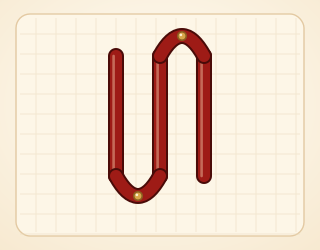
Add the second loop加第二个耳
Repeat beside the first, mirroring it. Two equal loops, side by side, are the seed of the whole lattice.在旁边重复一次,方向镜像。两个一样大的耳并排,就是整张格纹的种子。
Weave over and under上下穿编
Take the working end across both loops, passing over the first strand and under the second. Then turn and come back, reversing the pattern.把工作端横过两个耳,从第一股上面过、第二股下面穿。然后转向回来,把顺序反过来。
Tighten evenly均匀收紧
Pull one loop a little, then its opposite. Work around the knot in pairs until the lattice is firm and the eight edge loops are the same size.先轻轻拉一个耳,再拉它对面那个。成对地绕着结调整,直到格纹变实、边缘八个耳一样大。
Finish收尾
Sew the two ends into the back of the knot with a matching thread, trim, and add a tassel below and a bead above. Press flat under a book overnight.用同色线把两个端头缝到结的背面,剪齐,下面加流苏、上面加珠子。夹在书里压一夜,让它平。
Troubleshooting常见问题
The three mistakes everyone makes几乎人人都会犯的三个错
Mistake 1错误 1
Pulling one loop hard to “fix” the shape.用力拉一个耳,想“修正”形状。
Do this instead应该这样
Work around the knot in opposing pairs. One hard pull steals cord from the other side and the lattice goes lopsided.成对地、对着拉。猛拉一边会从对面偷走绳量,格纹就歪了。
Mistake 2错误 2
Cutting the cord exactly to the length of the finished knot.按成品结的长度剪绳。
Do this instead应该这样
Allow about a third extra. A tight Pan Chang eats cord; a short working end cannot be finished neatly.多留约三分之一。收紧的盘长很吃绳;工作端太短,收尾就收不干净。
Mistake 3错误 3
Repeating the same over-under direction on every pass.每一遍都用同一个上下方向。
Do this instead应该这样
Alternate. Identical crossings make a mat, not a knot; the lattice needs the weave to reverse at each turn.要交替。完全相同的交叉只会编成一张席,不是结;格纹需要每次转向都反过来。
Practice plan练习计划
Tie the same knot four times in a week. The first is for understanding the path, the second for tension, the third for speed, the fourth for neatness. Most learners can produce a presentable Pan Chang on the fourth attempt — which is exactly what our team found during the recorded practice session.一周里把同一个结编四次。第一次是弄懂路径,第二次是张力,第三次是速度,第四次是工整。多数人在第四次就能编出一个像样的盘长——这也正是我们团队在录制的练习里体会到的事。