Where you see it在哪里见
New Year door hangers, birthday gifts for grandparents, lacquer boxes, the China Unicom logo.新年的门挂、送长辈的寿礼、漆盒,以及中国联通的标志。
A square lattice with no beginning and no end — the knot that says “may this continue”.一张没有起点也没有终点的方格网——它在说“愿此绵延”。
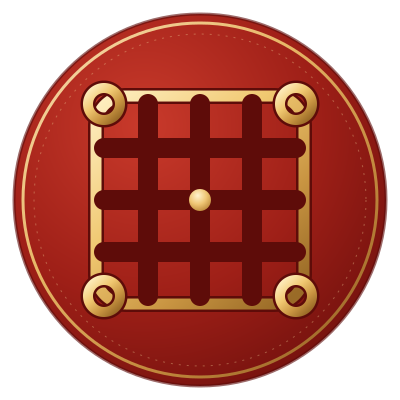
The form形制
The Pan Chang is built as a lattice: pairs of horizontal and vertical cords that pass over and under one another, then turn at the edge into loops.盘长结是编出来的格子:成对的横线与竖线互相上下相压,到了边缘再回环成耳。
Count the crossings and you find the point of the design. There is no loose end and no starting corner — the eye keeps travelling, which is exactly the wish. The older name of the knot is 盘肠 pán cháng (“coiled intestines”), a reference to the long, winding length of the gut; 肠 was later replaced by its homophone 长 cháng, “long”.数一数交叉点,就摸到了这个设计的用意。没有线头,也没有起点的角——眼睛会一直往下走,而这正是一个愿望。它更早的名字是盘肠 pán cháng(盘起来的肠子),取肠子长而曲折之意;后来“肠”被同音的长 cháng 取代。
The lattice also appears as a flat pattern — 盘长纹 — on Ming and Qing bronzes, lacquer, embroidery and window frames, where it is stretched into a border that can run around a whole object.这张格纹也被摊平成图案——盘长纹——出现在明清的铜器、漆器、刺绣和窗格上,被拉成一道能绕着整个物件走一圈的边饰。
Origin来历
The Pan Chang's ancestor is the śrīvatsa — the “endless knot” — one of the Eight Auspicious Symbols of Buddhism, alongside the lotus, the wheel and the conch. In Tibetan art the same motif is a favourite on textiles and door curtains; in Chinese it entered the decorative vocabulary through Buddhist and Central Asian routes.盘长的祖型是 śrīvatsa——“盘长”,佛教八吉祥之一,与莲花、法轮、法螺并列。在藏传艺术里,同一个母题常出现在织物与门帘上;在中国,它经由佛教与中亚的路径进入装饰语汇。
By the Ming and Qing dynasties it had become thoroughly domestic: a knot for a pouch, a border for a robe, a hanging for a New Year doorway. Red silk and a long tassel turned a religious symbol into a household blessing.到明清,它已经完全家常化:荷包上的一个结、袍子上的一道边、新年门楣上的一挂。红绸与长流苏,把一个宗教符号变成了家宅的祝福。
Its modern life is oddly corporate: the lattice forms the logo of China Unicom, chosen in the 2000s precisely because it reads as “connection without end”.它今天的生活有点“企业化”:中国联通的标志就是这张格纹,2000 年代选用它,正是因为它读起来像“连接不断”。
Continuity.绵延。 The path never ends, so neither should the thing you wish for — a marriage, a business, a life.路没有尽头,你祝的那件事也不该有——一段婚姻,一桩生意,一生。
Interconnection.相扣。 Every cord depends on the one beside it. In Buddhist reading, that is a picture of how things hold each other up.每一根线都靠旁边那一根。以佛教的读法,这就是万物互相支撑的样子。
Return.回环。 The loops turn back on themselves, the way good fortune is supposed to come around again.耳自己转回自己——就像好运应当再绕回来。
New Year door hangers, birthday gifts for grandparents, lacquer boxes, the China Unicom logo.新年的门挂、送长辈的寿礼、漆盒,以及中国联通的标志。
Elders and long-married couples above all. It is the knot of “may this last”, not of new beginnings.首先是长辈与结婚多年的夫妻。它是“愿此长久”的结,不是“从头开始”的结。
A long red tassel below, a jade bead or a coin above. The vertical drop is part of the design.下面配长红流苏,上面配玉珠或铜钱。这条垂直的坠子是设计的一部分。